

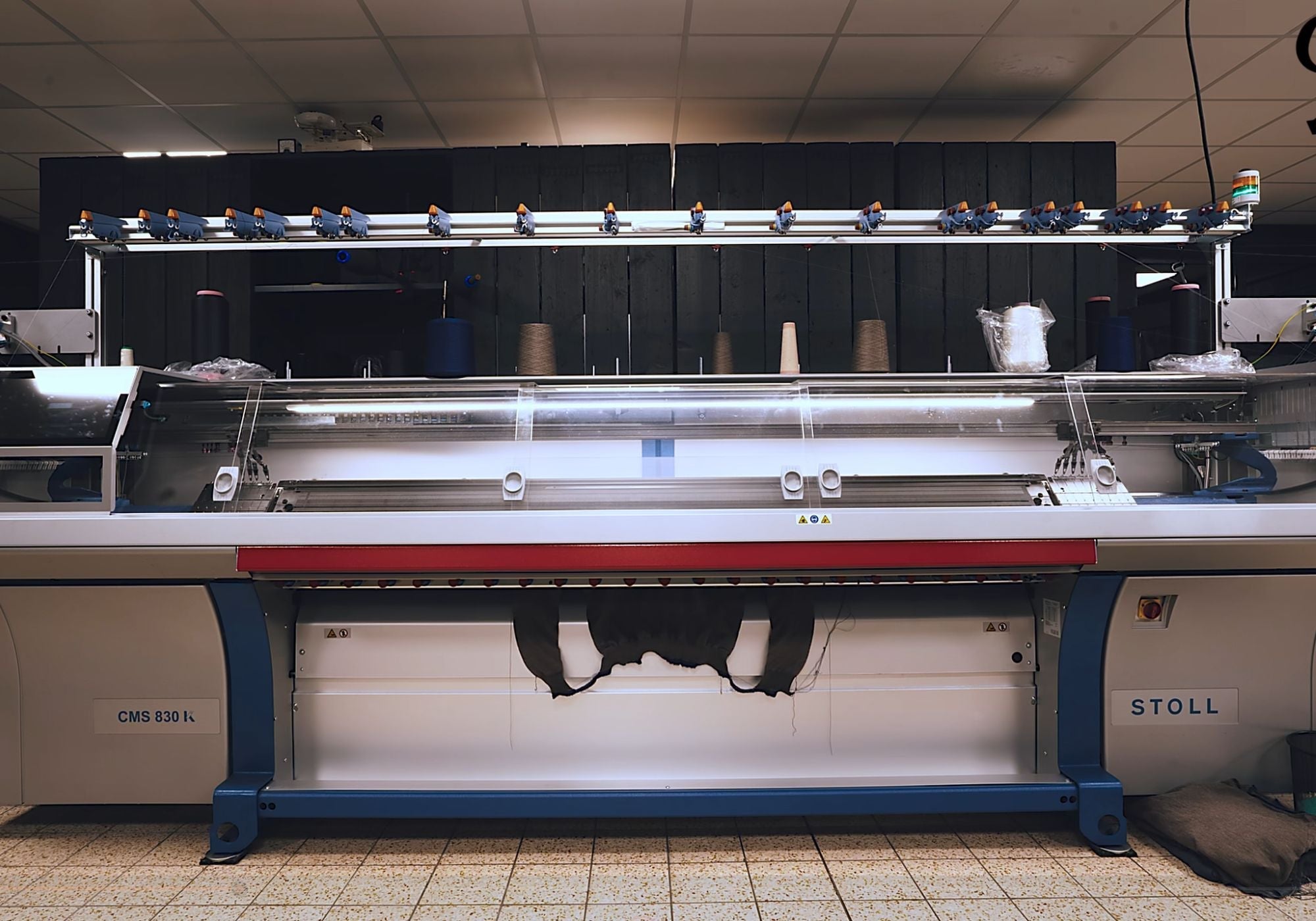
Whole-garment, knit and wear 3D knit technology
The difference between seamless knitting techniques
In short
- Seamless knitting means that a garment comes out of the machine as one piece, without separate panels and without side seams.
- WHOLEGARMENT is not a general technique but a brand name of the Japanese manufacturer Shima Seiki, introduced in 1995.
- The name WHOLEGARMENT may only be used for products knitted on Shima Seiki machines.
- The German manufacturer Stoll uses the term knit and wear for the same family of products and more broadly refers to 3D knitting technology.
- 3D knitting technology is the neutral, descriptive term for garments seamlessly knitted in three dimensions, regardless of the machine brand.
- For the wearer, what matters most is the result: no side seams, a stable shape, and little leftover material.
Anyone who looks into seamless sweaters quickly comes across three terms that are often used interchangeably: whole-garment, knit and wear, and 3D knitting technology. At first glance, they seem to describe the same thing. Yet there's an important distinction between them. One is a registered brand name, the other a neutral technical term. This article explains where these terms come from, why whole-garment can't simply be applied to every seamless sweater, and what 3D knitting technology actually means. That way, you'll not only know how a seamless sweater is made, but also why the chosen term matters.
What is seamless knitting exactly?
In traditionally knitted clothing, separate panels are knitted, cut out, and then stitched together. Front and back panels, sleeves, collar: everything is made separately and then assembled. With seamless knitting, this doesn't happen. The sweater is knitted as one piece, three-dimensionally, directly in the machine. The result is a complete garment, without side seams and without assembly afterward.
That difference is more than a technical detail. Seams are the spots where a sweater tends to chafe, stretch out, or twist out of shape. Leaving them out results in a garment that holds its shape better and feels calmer against the skin. Why the absence of seams makes such a difference for wearing comfort is a story in itself; we've previously described why no seams means more wearing comfort.
Technically, this happens on a flatbed knitting machine with two needle beds facing each other. By cleverly controlling the needles on both beds, tubular sections are created that are already connected to each other during knitting. In this way, the machine builds up a complete garment layer by layer, including sleeves and collar, without anything needing to be assembled afterward. It's essentially three-dimensional knitting instead of flat knitting followed by sewing.
Where the term whole-garment comes from
WHOLEGARMENT sounds like a generic name for seamless clothing, but it isn't. It's a brand name. The term was coined by Shima Seiki, which brought the first machine for seamless, three-dimensionally knitted clothing to market. This happened in 1995, in Wakayama, Japan. The machine, and the clothing that came out of it, were given the name WHOLEGARMENT, which was subsequently registered as a trademark.
Important detail: that name is protected. The WHOLEGARMENT label and brand name are reserved for products knitted on Shima Seiki's WHOLEGARMENT machines, down to the suppliers involved. A sweater made on a different machine formally may not carry the term, no matter how seamless it is. Using whole-garment as a generic word for seamless knitting is essentially using a brand name the way people call diapers "Pampers."
Knit and wear and 3D knitting technology: the German route
Shima Seiki isn't the only one that knits seamlessly. The other big name comes from Germany: the renowned German knitting machine manufacturer Stoll, part of the Karl Mayer Group since 2020. Stoll builds flatbed knitting machines in Reutlingen and has a long tradition in the craft.
For its seamless, one-piece knitted items, Stoll doesn't use the term whole-garment, but its own designation, knit and wear. In addition, Stoll and Karl Mayer speak of 3D knitting or 3D knitting technology, as a broader description of clothing that comes out of the machine three-dimensionally and complete. That's not a marketing trick, but simply the terminology that belongs to these machines. The outcome is comparable to that of Shima Seiki: a seamless, 3D-knitted production process that leaves almost no leftover material, because nothing is cut out.
Why the term matters
This is where the threads come together. Whole-garment, knit and wear, and 3D knitting technology largely describe the same end result, but they're not interchangeable. Whole-garment is tied to a brand and a machine. Knit and wear belongs to Stoll. 3D knitting technology is the neutral, descriptive term that can be used regardless of which machine you knit on.
That explains why a brand that knits on a Stoll machine doesn't speak of whole-garment but of seamlessly knitted or 3D knitting technology. It's not a matter of preference, but of accuracy. The confusion arises because whole-garment became known first and has since come to function as a generic term in everyday speech, even though it legally isn't one.
| Term | Type | Origin | Machine |
|---|---|---|---|
| WHOLEGARMENT | Registered brand name | Shima Seiki (Japan) | Shima Seiki machines |
| Knit and wear | Brand-specific product term | Stoll (Germany) | Stoll machines |
| 3D knitting technology / 3D knitting | Neutral, descriptive term | Generic | Various manufacturers |
| Seamlessly knitted | General English term | Generic | Various manufacturers |
What it means for the sweater itself
For most wearers, the brand name in the background matters less than what the technique delivers. And that's concrete. A seamlessly knitted sweater has no side seams, so there's no ridge chafing against your side. The shape is knitted in rather than stitched, making the garment less prone to losing its shape. Because nothing is cut out, little leftover material remains, making the method more economical with yarn than traditional garment manufacturing.
Why seamless knitting remains specialized
If seamless knitting has so many advantages, why isn't every sweater made this way? The answer lies in the machines and the expertise. A flatbed knitting machine that knits complete garments in one piece is complex, expensive, and requires experienced programmers who prepare the knitting work in detail. That combination of advanced equipment and craftsmanship isn't available everywhere. It explains why seamless clothing, despite decades of technical progress, has remained a niche rather than the norm. For a brand, it's a deliberate choice involving upfront investment, not a standard option you simply switch on.
The role of the fiber
A seamless construction says nothing about the yarn yet. In practice, seamless knitting is often combined with merino wool, and there's a reason for that. Merino is a fine fiber. The fiber diameter of merino, measured in microns, is so low that the fiber bends against the skin instead of pricking it. Fine fibers below about 19.5 microns are considered suitable for clothing worn directly against the skin.
Then there's temperature regulation. Research into the thermoregulation of merino wool shows that the fiber absorbs moisture and keeps the microclimate between clothing and skin more stable than many other materials. Combined with wool's naturally odor-resistant properties, this means: staying fresh longer, washing less often. Anyone who wants to dive deeper into the fiber can find more in our overview of the properties of merino wool.
These properties make merino particularly suitable for wearing directly against the skin, without a shirt underneath. The fiber is also elastic and springs back into shape, which pairs well with the shape retention of a seamless construction. Technique and material reinforce each other here: the construction holds the shape, the fiber provides comfort and temperature regulation. A seamless sweater made from a coarse, prickly wool would miss the point; it's precisely the combination that counts.
Common misconceptions
A few persistent assumptions, briefly corrected.
Whole-garment is a technique. Not quite. It's a brand name for a specific implementation of seamless knitting. The technique itself is more neutrally called seamless or 3D knitting.
Seamless is less sturdy. The opposite is often true. Seams are actually weak points. Without seams, tension is distributed more evenly across the garment.
All seamless clothing comes from the same machine. No. Shima Seiki and Stoll are two different manufacturers, from Japan and Germany, with their own systems and their own terms.
Frequently asked questions
Is 3D knitting technology the same as whole-garment?
The end result is similar: a seamless, one-piece knitted garment. The difference lies in the term. Whole-garment is a brand name owned by Shima Seiki, while 3D knitting technology is a neutral, descriptive term independent of the machine brand.
Why can't every seamless sweater be called whole-garment?
Because WHOLEGARMENT is a registered brand name reserved for products knitted on Shima Seiki machines. A seamless sweater made on a different machine formally may not carry the term, even if it's just as seamless.
Are seamless sweaters less sturdy than stitched ones?
Usually not. Seams are often the first spot where wear or distortion occurs. Because a seamless sweater is knitted as one piece, tension is distributed more evenly and the garment holds its shape better.
What kind of machine is a seamless sweater knitted on?
On an advanced flatbed knitting machine. The two best-known manufacturers are Shima Seiki from Japan and Stoll from Germany. Both make machines that can knit a complete garment three-dimensionally and without seams.
About Meedin
Meedin knits merino wool sweaters for men in its own workshop in Staphorst, with textile roots dating back to the 1950s. The knitting is done on a German Stoll machine, with which every sweater is created seamlessly and in one piece. That's why Meedin deliberately speaks of 3D knitting technology and not whole-garment: it's the correct, neutral term for this way of knitting. Check out the seamlessly knitted merino wool sweaters for the result.
Sources consulted: Shima Seiki (WHOLEGARMENT), Knitting Industry, Knitting Trade Journal, and The Woolmark Company.