

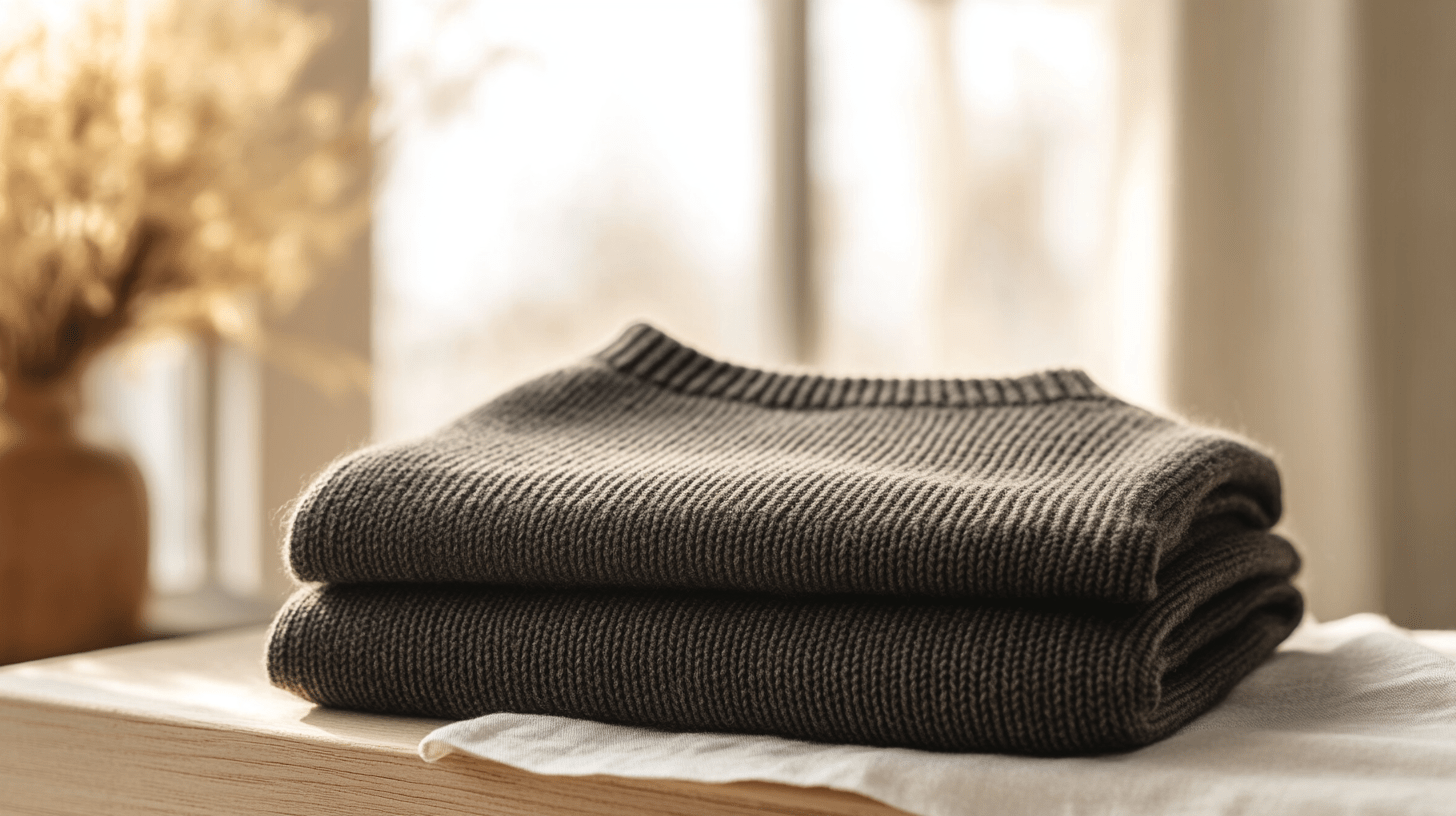
Does a Merino sweater pill?
Why our sweaters are less prone to pilling
In brief
- Pilling occurs when short fibers on the surface of a knit come loose through friction and form little balls.
- Three factors determine whether a merino sweater pills: fiber length, yarn twist, and the amount of friction during wear.
- A consistently knitted sweater lacks the typical friction zones around side and sleeve seams, where pilling on traditional sweaters usually begins.
- Our sweaters are fully fashioned in one piece on a whole-garment machine, using 100% long merino fibers and a tight twist.
- With cold water, a wool cycle, a mild wool detergent, and no tumble dryer, a merino sweater stays beautiful for longer.
- If pilling does appear, a wool comb or fabric shaver restores the surface in five to ten minutes.
A wool sweater covered in fluff after just a few washes. For many people, that is the main reason to pass on it, no matter how soft and warm the fabric is. Fluffing, pilling, or, in technical jargon, bouloching: it always comes down to the same phenomenon. So the question of whether a merino sweater pills is a fair one, and the answer is nuanced. Pilling is not random, but the result of three interacting factors: fiber quality, knitting technique, and care. A merino sweater that does not pill, functionally not visibly within the first few years, is definitely possible, provided the right choices have been made on all three fronts. In this article, we explain how pilling occurs, why our distinctive sweaters are less susceptible to it, and how to prevent fluff or, if it does appear, deal with it in just a few minutes.
What is pilling, exactly?
Pilling, also called fluffing or bobbling in Dutch, is the formation of small balls on the surface of a garment. Those balls form because short fibers come loose through friction, twist around each other, and remain attached to the fabric because other fibers hold them in place. It is a phenomenon that can occur in both woven and knitted fabrics: cotton, wool, cashmere, polyester, acrylic. The difference lies in how quickly it develops and how easily it disappears.
According to the Woolmark Company on pilling the phenomenon mainly occurs in places where the garment constantly comes into contact with other surfaces: elbows, armpits, sleeves, stomach area, and the visible parts of the sweater. No manufacturer can ensure that a sweater will never pill, but the causes are predictable and manageable.
Three causes of fluff on a wool sweater
in fact, pilling always comes down to three things.
Fiber length. Short fibers (under 30 mm) come loose much faster than long ones. High-quality merino wool consists of relatively long, fine fibers that stay firmly in the twist of the yarn. Cheap merino wool, or wool blends spun from short leftover fibers, already show visible pilling after a few washes.
The twist and yarn quality. A tightly spun yarn holds fibers better. A loose, airy yarn feels softer right away, but sheds fibers more quickly. So it is really a fundamental choice: maximum softness at first touch, or a slightly firmer hand that stays beautiful over time. We choose the latter.
Friction during wearing and washing. Pilling always develops in places that rub often. Under the arms, along the side seams, on the sleeves where bags or jackets brush against them, on the seat area when sitting regularly at a desk. That last point is why traditional knitted sweaters usually pill first around the seams: that is where the friction is concentrated on a double line of fabric.
Why does manufacturing make a difference?
Our knitwear is made using the so-called whole-garment technique. That means the entire garment comes out of the knitting machine in one piece, without side seams, shoulder seams, or sleeve seams. For pilling, this is relevant for two reasons.
First, the practical friction zones around seams disappear. Without an unnecessary fabric line at the side or under the arms, there is less local tension on the knit, and therefore less concentration of fluff in one place. Woolmark documents on whole-garment knitting technology that the technique delivers superior comfort and a better finish, precisely because there are no seams against the skin.
Second, the absence of seams creates a continuous yarn pattern. The knit has one uninterrupted structure, instead of separate panels stitched together. That gives a more stable surface, so fibers come loose less quickly.
Seamless does not mean a sweater can never pill. That promise would be worthless. It means that one of the main structural causes of pilling is reduced, rather than only being treated afterward with chemical coatings.
The role of yarn and fiber quality
Alongside construction, the quality of the yarn determines whether a sweater stays beautiful after a few washes or not. We work exclusively with 100% fine-micron merino wool, with a tight twist. Long merino fibers, tightly twisted, stay in place better than coarse or short-spun wool.
That is also why a cheap wool sweater of unknown quality can be covered in fluff within a season, while a sweater made from functional merino wool can remain beautiful for years. The price of wool almost always reflects fiber length, fineness, and the care with which the yarn is spun.
How to prevent pilling: practical care
The right washing and wearing method largely determines whether a sweater pills. Four simple rules are enough, and you can find the full approach in the washing guide.
Wash in cold water on the wool cycle. Warm water and aggressive movement pull fibers out of their twist. A merino sweater does not need washing often anyway: airing it out on a nice day, or leaving it outside overnight, is usually enough thanks to wool's odor-resistant properties.
Use a mild wool detergent. Standard detergent contains enzymes that break down wool protein (keratin). A mild detergent specially for wool, without enzymes, protects the natural fibers and keeps the twist intact. Always follow the washing instructions on your sweater's care label, because each manufacturer may give slightly different ones.
Keep it out of the tumble dryer. The mechanical movement in a tumble dryer is the fastest way to cause pilling (and to distort your sweater permanently). Lay the sweater flat to dry on a towel, gently shaped back into form. Read here how to wash a merino sweater properly without damaging it.
Limit friction while wearing. A backpack with rough shoulder straps or a jacket with a coarse lining can eventually cause local fluffing. Nothing dramatic, but it explains why pilling sometimes suddenly appears in one spot.
What to do if pilling does occur
Pilling on a wool sweater does not mean the garment is worn out. With the right tools, you can restore the surface in a few minutes. Four methods, in order of delicacy:
- A wool comb. The most delicate option, suitable for fine knits. Move in one direction, not back and forth.
- A fabric shaver (also called a lint remover). Runs on mains power or batteries and quickly clears larger surfaces. Hold the device lightly against the fabric; do not press.
- A razor blade. Works in an emergency, but requires a steady hand so you do not cut through threads. Not our first choice.
- Tape or a lint roller. Removes loose fluff but does not solve the pilling pattern itself. Good as a quick refresh before you leave.
Lay the sweater on a table, stretch the fabric lightly, and work section by section. Five to ten minutes per sweater is usually enough. With a well-made sweater, you should only need to repeat this once or twice a year at most.
At Meedin
We produce our sweaters in Staphorst, in our workshop where textile expertise goes back to 1959. The choice of seamless knitting and 100% merino wool is not a marketing decision, but a direct attempt to eliminate the two main causes of pilling: friction around seams and short, loose fibers. Explore our collection of merino sweaters for men or read the complete merino guide if you want to learn more about a good wool sweater.