

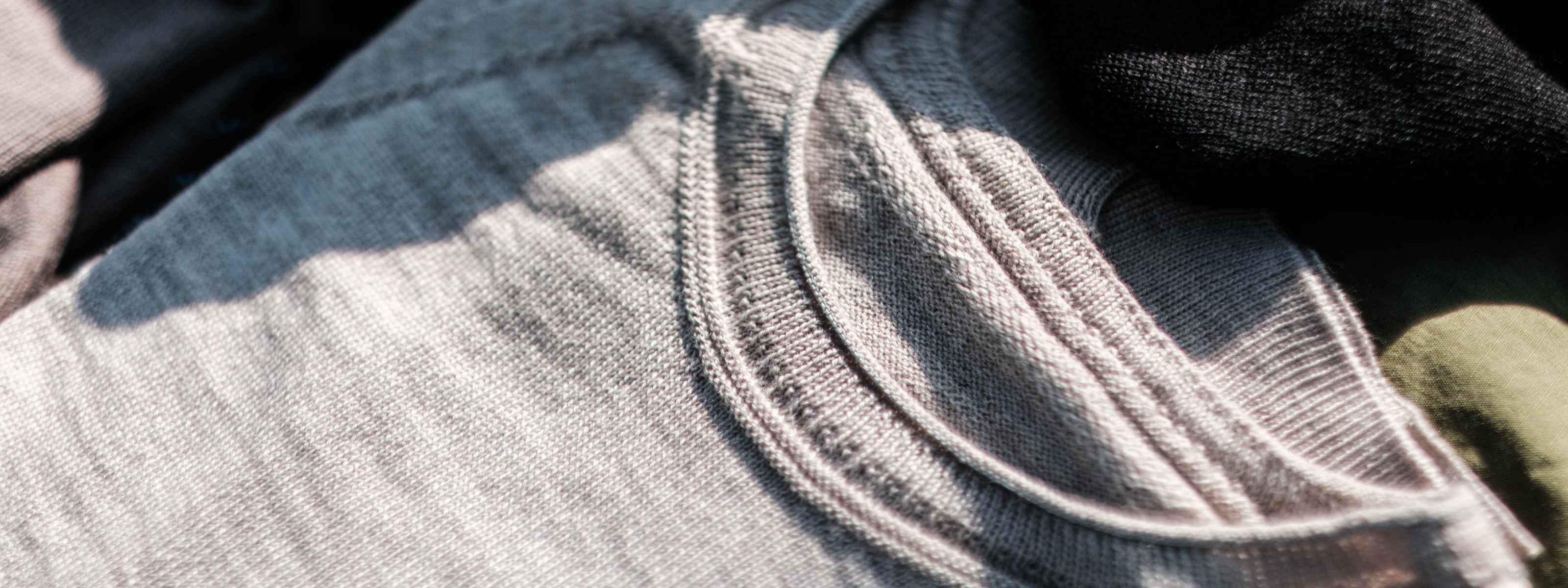
Merino T-Shirt for Outdoor and Sport
The perfect functional base layer
In short:
- Merino wool regulates your body temperature: cooling during exertion, insulating in the cold. That's why a merino T-shirt works as a base layer year-round.
- The fiber absorbs moisture as vapor, up to about 35% of its own weight, and therefore feels dry for longer during sports.
- Merino resists odor. You wear the same shirt multiple times, even on a multi-day trip, without it starting to smell.
- For outdoor and sport, wear it as a loose shirt in summer or as a first layer under a sweater in winter.
- Meedin's merino T-shirts are seamlessly knitted in the Netherlands, in crew neck and V-neck, without side seams that chafe.
A cotton shirt on a long hike: after an hour it clings to your back, cools down as soon as you stop, and smells by evening. Anyone who regularly exercises outdoors knows that. A merino T-shirt for outdoor and sport removes most of that discomfort. Not because it's a technical miracle, but because the wool fiber naturally does what a base layer should do: regulate heat and manage moisture. Below we explain why merino wool works as a functional base layer, when to wear a loose shirt and when to layer it under another piece, and what to look for in fit and care.
Why a merino T-shirt works for outdoor and sport
A functional base layer, called a base layer in English and sometimes a merino undershirt in Dutch, has one job: keep your skin climate stable. The key lies in two properties: merino wool regulates temperature and it moves moisture. During exertion, the fiber wicks moisture vapor from your skin, which helps with cooling. When the temperature drops, the same layer retains warmth.According to the Woolmark Company on merino wool as a base layera merino base layer cools in summer through evaporation and insulates extra in winter.
The difference with synthetic fabric is in how moisture is handled. Merino absorbs moisture into the fiber itself, as vapor, rather than leaving it as a film on your skin. That's why the shirt feels dry for longer, even if you've been active for a while. For hiking, cycling, or running at moderate intensity, that's exactly what you want: a shirt that doesn't feel clammy the moment you take a break.
Wear multiple times, without odor
For many people, this is the deciding reason to switch. Merino resists odor formation. Research cited by the Woolmark Company on odor and woolshows that wool fabrics retain 66% less body odor than polyester and 28% less than cotton. That's because the fiber absorbs a lot of water vapor, up to about 35% of its weight—twice as much as cotton and thirty times as much as polyester.
In practice, that means less washing. A merino T-shirt airs out after use and you often simply wear it again. On a multi-day hut-to-hut trek or a weekend with limited luggage, that saves a bag full of spare shirts. One shirt, multiple days.
Summer, winter, and layering: how to wear it
A merino shirt is not a seasonal product. In summer you wear it loose, as the only layer. It's breathable and wicks heat, so merino stays comfortable even at higher temperatures. Once it gets colder, the role shifts: then it's your first layer, directly on your skin, with, for example, a wool sweater with crew neckover it. That combination works because both layers allow moisture to pass through rather than trap it.
The advantage of a thin base layer is that you can easily adjust. If it gets warm while climbing, you take off the sweater and stay in your T-shirt. Standing still at a viewpoint, the layer goes back on. That way you stay comfortable across a wide temperature range with few pieces of clothing.
Seamlessly knitted: less friction in motion
Our T-shirts are knitted seamlessly in one piece, with a textile heritage in the Netherlands dating back to 1955. Read more about that approach on our about Meedinpage. For sport, that seamless construction is no detail. A classic shirt has side seams, and those seams rub against a backpack strap or with repeated movement. Without a side seam there's less friction and therefore less chance of irritation over longer distances.
The same technique uses yarn efficiently: about 25% less waste remains than with traditional cutting and stitching. That's not a reason to buy a shirt, but it's part of how it's made.
Crew neck or V-neck, and the right fit
Meedin's merino T-shirtscome in crew neck and V-neck, both in 100% merino wool. Functionally, the neckline makes little difference for sport. It's mainly a matter of style and what you wear over it. The crew neck is neutral and works both loose and as a base layer under a sweater. The V-neck stands out under a shirt or a sweater with an open collar.
More important than the neckline is the fit. A base layer fits best slightly snug, so moisture stays in contact with the fiber and the shirt doesn't bunch under a layer. Generally choose your normal size and adjust the length to your body height. If you're unsure between two options, consult sizes and fit.
Care after training
Merino doesn't ask for much, but it does need the right attention. After sports, air out the shirt well first; often that's enough to wear it fresh again. Wash only when necessary, on a wool wash program at 30 degrees, turned inside out beforehand, with a wool-friendly detergent without fabric softener. Dry flat, not in the dryer. That way the shirt keeps its shape and lasts for years. The full explanation is in caring for merino wool.
Conclusion
A merino T-shirt for outdoor and sport is not a gadget, but a base layer you wear much of the year: cool during exertion, warm in the cold, dry for longer in use, and fresh after wearing multiple times. A loose shirt for summer, your first layer under a sweater for winter. Choose your size based on fit and length, air more than you wash, and you have a garment that requires little maintenance and delivers a lot.
Frequently asked questions
Is a merino T-shirt suitable for intense sports?
Yes. Merino wicks sweat as vapor and regulates temperature, so it stays comfortable during exertion. For very intense, short bursts of activity, some athletes choose an extra-thin merino shirt. For most outdoor activities, such as hiking, cycling, and running at moderate intensity, a merino T-shirt works well.
Can you wear merino wool in summer?
Yes. Merino is breathable and wicks heat and moisture, so it's comfortable even at higher temperatures. A thin merino T-shirt is therefore usable as a summer shirt, not just as a winter layer.
How often do you need to wash a merino T-shirt?
Less often than cotton or polyester. Merino resists odor, so usually airing out after use is enough. Wash the shirt only when really necessary, on a wool program at 30 degrees.
Crew neck or V-neck for sport?
Functionally it makes little difference. The crew neck is more neutral and works well as a loose layer and as a base layer under a sweater. The V-neck really shines under an open collar.
Does a merino T-shirt scratch your skin?
Merino wool has a fine fiber and feels soft, even directly on the skin. It wears differently than coarser wool types, which are more likely to itch.