

Men's Merino Wool Sweater: The Complete Guide
There is a difference between wearing a sweater and forgetting that you are wearing one. That second feeling is exactly what a good men's merino wool sweater can give when everything is right: the fibre, the construction, the fit. Not every sweater delivers that. Most sweaters that look good at first glance only reveal themselves after the first wash, after a long day at work, or after a year of wear. Meedin was founded on that philosophy: the sweater that truly worked did not exist. So it was made.
- A men's merino wool sweater from Meedin is fully knitted in one seamless piece using 3D knitting technology.
- Merino wool is thermoregulating: warm when it is cold, pleasantly cool in transitional temperatures.
- Every Meedin sweater is made in the Netherlands by a knitter who has been active in the sector since 1955.
- Seamless knitting reduces material waste by 25% compared to conventional cut-and-sew production.
- There is no label in the neck: the label is placed in the left sleeve, so nothing touches the skin.
- The sweater can be worn directly on the skin thanks to the fineness of the merino fibre.
This guide is about merino wool, about the way sweaters are knitted, about the difference between models, and about how to assess a men's merino wool sweater that is worth wearing for years.
Why merino wool? The fibre behind the choice
Wool is not just one thing. There are dozens of types of wool, from coarse sheep's wool to fine cashmere, and they all behave differently on the skin, in the wash, and after a year of intensive wear.
Merino wool comes from the Merino sheep, a breed that has been bred for centuries for its exceptionally fine fleece. Fibre thickness is measured in microns. Regular wool usually falls around 30 to 40 microns, which is the range where the fibre starts to feel itchy. Merino wool is significantly finer. The result is a fibre that the skin barely notices, even with direct contact. No itching, no irritation, even for people with sensitive skin.
That is already quite a difference compared to standard wool. But the real distinction lies in how merino wool performs under changing conditions.
Thermoregulating. Merino wool breathes in a way that synthetic fibres cannot replicate. The fibre absorbs moisture from its immediate environment and releases it gradually. As a result, merino wool helps keep body temperature stable: warm when it is cold outside, comfortable as temperatures begin to rise. For those who associate merino wool exclusively with winter clothing, that comes as a rediscovery. It is just as much a spring material. A men's merino wool sweater that you wear in November works differently in April, and it works.
Breathable. Synthetic materials trap moisture. Wool lets it pass through. That is the difference between a sweater that breathes and a sweater that traps you. A full day of work in a warm room, a train journey, a walk: merino wool adapts. Acrylic, polyester and nylon do not. They retain heat in a way that becomes uncomfortable as soon as conditions change.
Directly on the skin. Thanks to the fineness of the merino fibre, the sweater can be worn directly on the skin without needing an undershirt. That makes it more functional than it may seem at first glance: fewer layers, more freedom of movement, easier to wear. One piece instead of two.
Stays looking good with proper care. A common objection to wool is that it pills. That is true for many types of wool, but not as an absolute rule. Merino wool naturally stays looking good longer than coarser wool types. With proper care, gentle washing, no tumble dryer, drying flat, the sweater retains its surface texture well. Mechanical friction, for example from a shoulder bag or backpack, can cause some localised pilling, as with any type of wool. The way you care for it largely determines how long the sweater retains its quality. Everything you need to know about that can be found in our care guide for wool sweaters.
One nuance: blended materials, merino combined with acrylic, polyester or nylon, reduce the properties that make merino wool unique. Thermoregulation, breathability and softness all depend on the percentage of pure wool. A sweater made of 80% merino and 20% polyester wears differently from a sweater made of 100% merino wool. Not necessarily worse, but different, and it is useful to know that distinction before making a choice.
Seamlessly knitted: what that means in practice
Most sweaters are made by joining separate pieces of fabric together. Front panel, back panel, sleeves (and collar): each part is knitted or cut separately and then sewn together. Those seams are visible on the inside of the sweater, noticeable against the skin, and they create pressure points exactly where you least want them: the shoulder, the side of the torso, sometimes the inner arm.
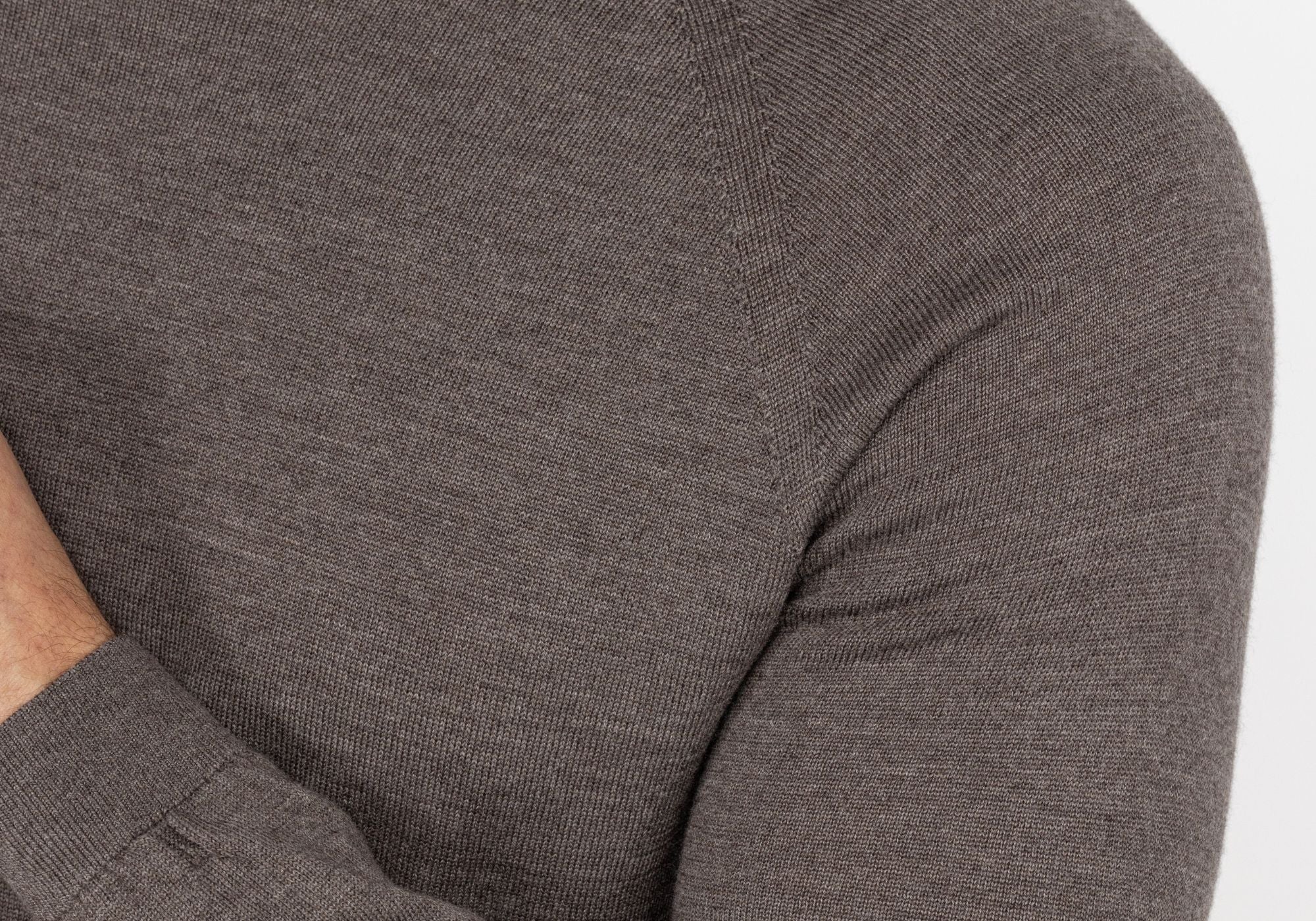
Meedin works differently. Every sweater is knitted using the whole-garment principle (3D knitting technology): a single piece, from start to finish, with no seams at the sides or shoulders. The technique is called seamless knitting or 3D knitting. The result is a sweater you do not feel in the places where seams would normally be.
That is not a cosmetic detail. For anyone who sits for long periods, moves actively, or wears a sweater directly on the skin, the absence of seams makes a real difference in everyday comfort.
No label in the neck. At Meedin, the label is placed in the left sleeve, not against the neck. A small decision with a logical outcome: no irritation at one of the most sensitive points, no snipping it out after purchase, no awareness of the sweater while you wear it. The label contains all production information, but it is placed where it does not interfere with anything.
25% less waste. 3D knitting uses the yarn in the most efficient way. No pieces are cut off and thrown away. In traditional garment production, a substantial part of the material is lost in the cutting and sewing process: unused pieces of fabric, cutting waste, excess material at the edges. Seamless knitting eliminates that loss and reduces material waste by 25% compared to the conventional method. Not as a marketing slogan, but as a technical consequence of the production method.
Stable fit. Without seams that can stretch, break, tear, or shift out of place after repeated washing, the sweater retains its structure for longer. The fit remains more stable over time. That contributes to its lifespan: a sweater that keeps its shape is worn longer and does not need to be replaced as quickly.
Anyone who wants to better understand how whole-garment knitting works and why that construction method delivers the results it does can visit our other articles on knitting craftsmanship and construction.
Made in the Netherlands: what that means in practice
Many brands use "Made in" as positioning. A story, an identity choice, a sales argument that sounds good but is difficult to verify. At Meedin, it is different.
Every sweater is produced in the Netherlands, in a workshop with a history going back to 1955. No recent startup operation, no outsourcing to an anonymous producer. Meedin does its own knitting. That means direct control over the knitting process, over the quality of the yarn, and over the precision of every step, from the first thread to the finished sweater.
That has a few concrete consequences.
Traceability. You know where your sweater was made. The production chain is short and documented. Not global, not "somewhere in Europe", but specific: with a particular knitter in the Netherlands.
Shorter transport chain. A sweater knitted in the Netherlands and sold in the Netherlands or Europe does not need to travel halfway around the world. That has a real effect on the product's total ecological footprint, even if it is rarely calculated precisely.
Local expertise that should not be taken for granted. The Dutch textile industry is small. The companies still active in it have decades of experience and deeply rooted craftsmanship.
Which model should you choose? Crew neck, turtleneck and the question of length
At Meedin, there are currently two core models: the crew-neck merino wool sweater and the merino wool turtleneck. Both are available in three lengths.
Crew neck. The most versatile model in the collection. Wearable over a shirt, under a jacket, or on its own on a day when you do not want to make choices. The crew neck suits almost any situation because it never overstates itself. It is present without standing out, which is exactly the point of a good basic piece.
Turtleneck. A more distinctive choice, but not necessarily more formal. A turtleneck replaces both scarf and shirt when you want to stay warm without layering. It works well on cold mornings, on autumn trips, on days when a crew neck offers too little protection around the neck. If you are unsure: once you wear a turtleneck, you quickly understand why it exists.
Three lengths. That is not ornamental. A sweater that ends at the right length feels fundamentally different from one that is too short or too long. Too short, and the line rides up with every movement. Too long, and the sweater loses its visual shape and feels heavier. The three available lengths make it possible to choose based on build, preference and how you want to wear the sweater: loose over trousers, or neatly tucked in. For help determining the right size, we refer you to our size guide. Returns are free if the size is not right after all.
The collection will soon be expanded with a merino wool V-neck and a men's merino T-shirt. Both follow the same production method and material logic as the current models: an extension of the same approach, not a new direction.
How long does a men's merino wool sweater last?
That is a question that says more about the purchase intention than about the sweater itself. Someone buying a sweater expecting to wear it for two seasons buys by different criteria than someone hoping to get five years out of it.
At Meedin, the starting point is clear. The sweater is made to last. The choice of whole-garment knitting, of 100% merino wool, of a construction without seams: all those decisions make the sweater more robust in daily use. Not because durability is a sales argument, but because it is the logical outcome of good material and good craftsmanship.
Merino wool is a resilient fibre. It recovers its shape after wear, retains its structure with proper washing, and has better resistance to pilling than coarser wool types. A sweater that is carefully maintained lasts for years and becomes more familiar with every season it is worn. That is also economically relevant: a one-time investment versus the cumulative cost of sweaters that lose their shape or become see-through after two winters.
The care is simple if you know the basic principles: wash gently at 30°C (wool wash programme) or cold, never tumble dry, and let it dry flat to preserve its shape. The full instructions can be found on our care page.
Transparent pricing: what a quality men's merino wool sweater costs
There are sweaters for sale for 30 euros that look good at first glance. There are also sweaters costing 300 euros that are difficult to justify when you look closely at the construction and material. Price alone tells you nothing, but price in relation to what is inside tells you everything.
Meedin does it differently. The price reflects the actual production costs: quality 100% merino wool, 3D knitting in-house, a Dutch knitter, free shipping and returns in the Netherlands and Europe, next-day delivery for orders placed before 18:00. There is no margin based on the buyer's lack of knowledge. The production chain is documented. Anyone who wants to understand why the sweater costs what it costs can ask.
That is both a moral and a business choice: a fair price creates a lasting relationship with the customer. The people who buy a Meedin sweater know what they are buying, they know where it was made and they know who made it. And they know what they are paying for.
How do you assess a men's merino wool sweater before buying?
Not every sweater that calls itself "merino" wears like merino. A few criteria make the difference.
The percentage. 100% merino wool is not the same as a "merino blend". Blended materials reduce the thermoregulating properties, the breathability and the softness on the skin. Check the label.
The construction. Look at the seams. A seamless sweater wears differently from a sewn one, in a real, noticeable way, especially with intensive use. Both are valid choices, but the distinction is real.
The weight. A lighter merino sweater is not necessarily lower quality. Weight determines wearing comfort in relation to temperature. A lighter sweater works well as a mid-layer or for transitional seasons.
The fit. A merino sweater should follow the shoulder and chest measurements accurately. Wool does not have stretch comparable to jersey: a sweater that is too small stays too small. If you are unsure about the size, use the size guide. Returns are free.
The details. The label, the cuffs, the neckline: a sweater that is well finished in the details usually is in the whole as well.
Meedin and the men's merino wool sweater
Meedin was founded in Staphorst from a clear starting point: the men's merino wool sweater that truly worked did not exist. Not because the technology was missing, but because the combination of whole-garment knitting, 100% merino wool and production in the Netherlands was rarely brought together in this way.
The sweaters are made by a knitter in the Netherlands who has been active in the sector since 1955. Every sweater is seamless, can be worn directly on the skin, and is available as a crew neck and a turtleneck, in three lengths. There are no labels in the neck. There is free delivery and free returns in the Netherlands and Europe. Ordered before 18:00, delivered the next day.
The collection is intentionally kept narrow. Fewer choices, better choices. An overview of everything available can be found in our collection of men's merino sweaters.
Conclusion
Buying a men's merino wool sweater is a choice you can get right once. The right fibre, the right construction, the right size: and then you wear it year after year without any reason to think about it. That is exactly the feeling a good sweater should give, present without standing out, functional without effort.
Merino wool offers thermoregulation, softness and durability. Seamless knitting offers comfort without pressure points. Production in the Netherlands offers traceability. Together, those three make a men's merino wool sweater a purchase that justifies its price over seasons, not weeks.